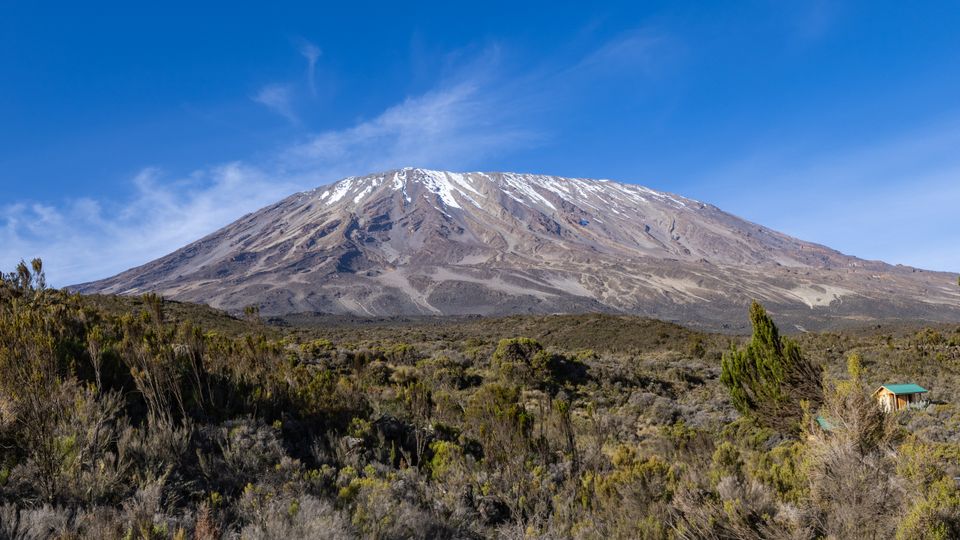
Kilimanjaro is not a technical climb - every standard route to Uhuru Peak (5,895m) is a walking trail - but it is a serious undertaking because of the altitude. Route choice and the number of days you allow matter more than anything else, and the Machame route over seven days is one of the more balanced options.
The route passes through every zone on the mountain: rainforest on the first day, then moorland, the high alpine desert around Lava Tower and Barranco, and finally the cold, barren summit area. Day three is the key acclimatisation day. You climb to Lava Tower at about 4,600m, then drop down to sleep at Barranco Camp, several hundred metres lower. Day four starts with the Barranco Wall, a non-technical scramble that most climbers end up enjoying.
Summit night begins before midnight from Barafu Camp. It is long, cold and tiring, and no route or schedule can guarantee you reach the top - your guide's judgement about your health comes first. Tents, mess tent, all meals on the mountain and a full crew of guides, cooks and porters are included. For a fuller picture, read our Kilimanjaro trekking guide.
Journey at-a-glance:Customize This Journey. Request More Information »
 MACHAME CAMP (2,835M)
A summit attempt on Uhuru Peak (5,895m), the highest point in Africa
Five vegetation zones from rainforest to the summit's ice and rock
Climb-high, sleep-low acclimatisation via Lava Tower
The Barranco Wall scramble - non-technical but exposed in places
After registration at Machame Gate, the trail climbs steadily through dense montane rainforest, gaining just over 1,000m. It is often damp and muddy underfoot. You reach Machame Camp by late afternoon, where the crew will already have set up tents.
The forest thins into heath and moorland, and the views open up across the Shira Plateau. It is a sustained climb of around 900m, and many people start to feel the altitude on this stretch.
The acclimatisation day. You climb to Lava Tower for lunch at around 4,600m, then descend into the Barranco Valley to sleep several hundred metres lower. Going high and coming back down like this is one of the main reasons Machame acclimatises well over seven days.
The day starts with the Barranco Wall, a scramble where you will use your hands in places. It is not technical, but parts are exposed. After the wall the trail undulates across ridges and valleys to Karanga Camp, with little overall height gain - a useful rest for your body.
A short walk across stony alpine desert to Barafu, the base camp for the summit. You arrive around midday. The rest of the day is for resting, eating and preparing kit before an early night.
You set off before midnight, climbing slowly over loose scree and switchbacks by headtorch. If conditions and your acclimatisation allow, you reach the crater rim and then Uhuru Peak around sunrise. After a short time at the top you descend to Barafu for rest and food, then continue down to Mweka Camp. It is a very long day.
The last descent back through the rainforest to Mweka Gate, where climbers who reached the crater rim or summit receive their certificates. Your vehicle then takes you back to your hotel in Moshi or Arusha.
Planning tip: see our guide on Kilimanjaro Trekking Guide: Routes, Acclimatisation and Summit Night.
Accommodation: Tented camping on the mountain (tents, mess tent and portable toilet provided). Hotel nights in Moshi or Arusha before and after the climb are not included but we can book them.
Vehicle: Transfer vehicle between Moshi/Arusha and the trailhead
The two main dry windows are roughly late June to October and December to mid-March. The long rains (around April and May) are generally avoided; a shorter rainy period around November can also affect conditions.
Full Mount Kilimanjaro destination guide »
Park, camping and rescue fees, all meals on the mountain and camping equipment are included
Tips for the crew are not included - we give you guidance on customary amounts before the climb
Insurance that covers trekking to 6,000m and evacuation is essential
The extra day gives your body more time to adjust before summit night. That is widely considered to improve both comfort and the chance of reaching the top, though no schedule can guarantee it.
You need to be able to walk 5-7 hours a day for several days in a row, plus one very long summit day. Training with long hikes on consecutive days in the months before is the best preparation.
We do not publish a figure because we do not hold verified statistics. Longer routes like the 7-day Machame are generally regarded as one of the better options, but altitude affects everyone differently and guides will turn people back if their health is at risk.
Warm layers for temperatures well below freezing, a four-season sleeping bag, waterproof boots, gloves, a headtorch and trekking poles. Most technical items can be hired in Moshi or Arusha.
Send us your travel dates and group size and we'll confirm availability and pricing.